
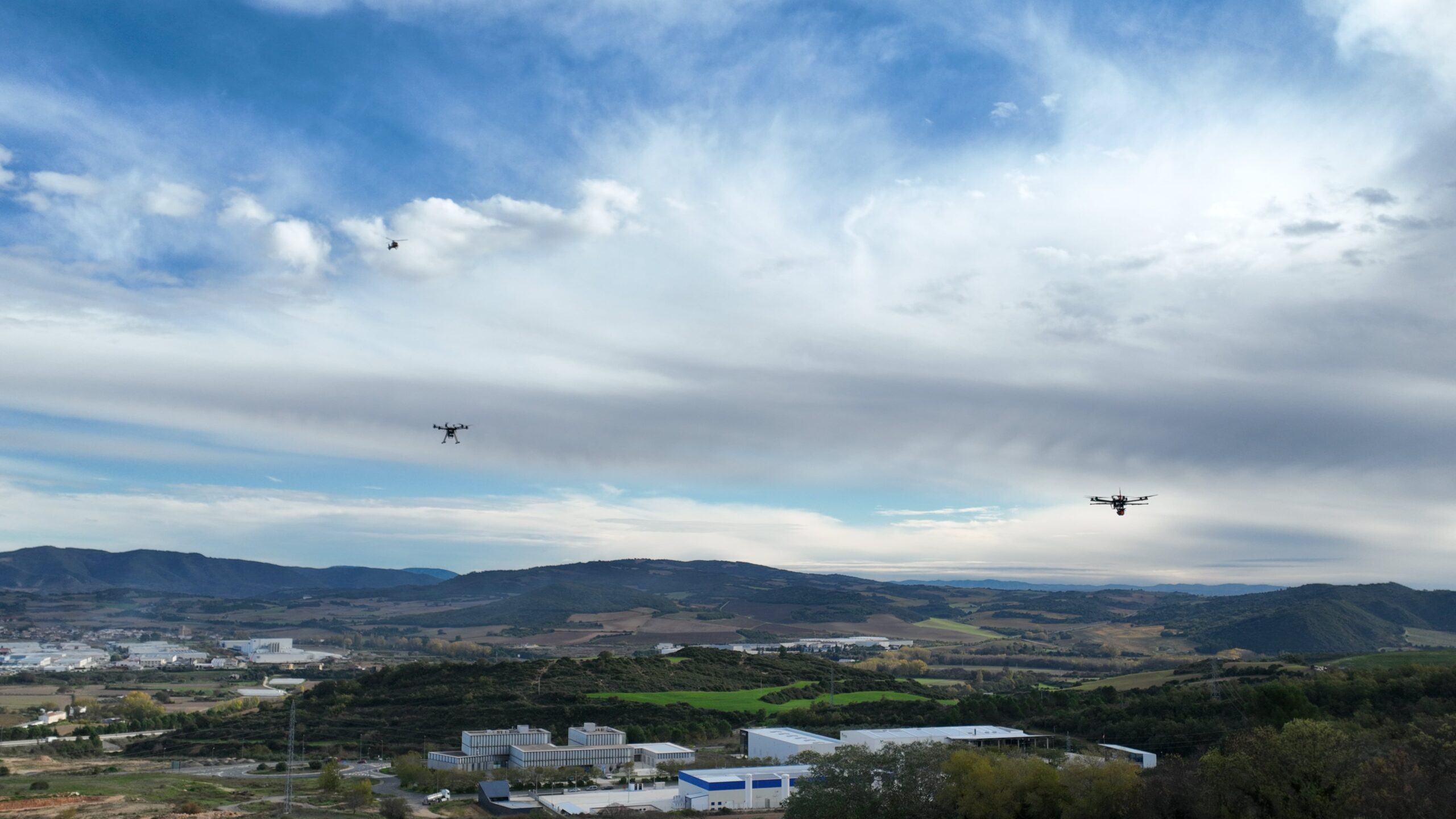
The Regional Government of Navarre (Spain) has carried out a new flight test involving manned and unmanned aircraft, specifically four drones, one from the Navarre delegation, and a Government of Navarre helicopter, simulating the search for a person who disappeared while walking the Pilgrim’s Way to Santiago de Compostela in the vicinity of Estella-Lizarra. This action is part of the European U-ELCOME project, in which Navarre participates along with other communities in Spain and regions of Italy and France to explore the use of drones in different areas.
Specifically, the place chosen for the test was the surroundings of the NAITEC headquarters. The flight of the aircraft has been monitored, within the parameters required by ENAIRE and EUROCONTROL, through software that manages and controls drone flights in environments that are considered dangerous, either because they are security zones or because they are areas where manned and unmanned aviation converge.

The aim of these tests is to gather data during the preparation of the tests and the flights carried out, in order to detect possible faults in the systems and provide data for their correction.
These tests are part of the work of the Government of Navarre for the future development of the region and its pioneering position in the integration of automated drone operations in Spanish airspace, as well as the implementation of this technology applied to emergency response such as rescue, firefighting, traffic management, location of people or inspection of critical infrastructures.
The SESAR DSD project U-ELCOME is aimed at developing solutions for the coordination of manned and unmanned flights in overlapping airspace. It is organised under the general supervision of EUROCONTROL and has a leader in each of the three participating countries, with ENAIRE in Spain. The Navarre delegation participating in this project includes the Government of Navarre through the Regional Police, together with the Public University of Navarre (UPNA), the NAITEC technology centre and the company FUVEX.
This project has received funding from the European Climate, Infrastructure and Environment Executive Agency (CINEA) under grant agreement No 101079171.


